
Getting your website onto the first page of Google can make a major difference to your business. Higher rankings can bring more visitors, improve brand visibility, and help you connect with people who are already searching for your products or services.
However, ranking higher is not about adding keywords to a page and waiting for Google to notice it. Search engines consider many aspects of a website, including content quality, technical performance, relevance, authority, user experience, and search intent.
A successful SEO strategy brings these elements together. You need to understand what your audience searches for, create content that genuinely helps them, keep your website technically healthy, and continue improving your pages based on real performance data.
In this guide, we’ll look at practical ways to rank higher on Google and explain how SIPL (Shakambari Infotech Pvt. Ltd.) helps businesses improve their online visibility through customized SEO strategies.
Why Google Rankings Matter
Most people don’t look far beyond the first few search results when they need an answer, product, or service. If your website appears near the top for relevant searches, you have a better opportunity to attract potential customers.
Higher Google rankings can help your business achieve:
- More organic traffic
- Greater brand visibility
- Better online credibility
- More qualified visitors
- Increased enquiries
- More potential customers
- Long-term organic growth
Organic search can become a valuable source of business growth when your website consistently provides useful information and a strong user experience.
Start with the Right Keyword Research
Keyword research should be the foundation of your SEO strategy. Before creating or optimizing a page, understand what your potential customers actually type into Google.
Don’t focus only on keywords with high search volume. A keyword may receive thousands of searches but still bring very little business if it doesn’t match your audience or services.
Look for keywords that have:
- Relevant search intent
- Reasonable competition
- Commercial value
- A clear connection to your services
- Potential to attract your target audience
For example, a Jaipur-based digital marketing company may target terms such as:
- SEO Company in Jaipur
- Digital Marketing Company Jaipur
- Google Ads Agency Jaipur
- Local SEO Services Jaipur
- Website Development Company Jaipur
Long-tail keywords can also be valuable because they often represent more specific searches and clearer user needs.
Match Your Content with Search Intent
One of the biggest SEO mistakes is creating content without understanding why someone searched for a particular keyword.
Searchers may want:
- An answer to a question
- A detailed guide
- Product information
- A comparison
- A local service
- A specific company
- Advice before making a purchase
Your page should satisfy that purpose.
For example, someone searching “SEO vs Google Ads” is likely looking for a comparison rather than a page that only promotes SEO services. Similarly, someone searching “SEO Company in Jaipur” may be looking for service providers and pricing information.
When your content matches the reason behind the search, visitors are more likely to find it useful.
Create Helpful, Original Content
High-quality content remains an important part of a strong SEO strategy. Instead of writing articles simply to include keywords, create content that solves real problems.
Good content should:
- Answer the reader’s questions
- Explain difficult topics clearly
- Include useful examples
- Provide practical advice
- Demonstrate relevant experience
- Cover important aspects of the topic
- Avoid unnecessary repetition
For example, if you’re writing about local SEO, don’t simply define local SEO. Explain how businesses can optimize their Google Business Profile, improve local visibility, manage reviews, and build relevant local signals.
Useful information gives visitors a reason to stay on your website and explore other pages.
Improve Your On-Page SEO
On-page SEO helps Google understand the topic, relevance, and purpose of each page on your website. Optimizing your titles, headings, content, images, URLs, and internal links can make your pages easier for both search engines and visitors to understand.
Review important elements such as:
- Page title
- Meta description
- H1 heading
- H2 and H3 headings
- Primary and secondary keywords
- Internal links
- Image ALT text
- URL structure
Use keywords naturally rather than forcing them into every paragraph. Your content should always sound like it was written for people first.
Internal linking is also useful because it connects related pages and helps visitors discover more relevant information on your website.
Improve Website Speed and Core Web Vitals
A slow website can frustrate visitors before they even see your content. Speed and page experience should therefore be part of your SEO maintenance.
Look for opportunities to:
- Compress large images
- Use modern image formats such as WebP
- Reduce unnecessary scripts
- Remove unused plugins
- Improve server response time
- Use reliable hosting
- Optimize Core Web Vitals
- Enable browser caching where appropriate
A faster website can create a smoother experience for visitors and make it easier for them to interact with your content and services.
Make Your Website Mobile-Friendly
Your website should provide a smooth experience on smartphones, tablets, and desktop devices. A mobile-friendly design makes it easier for visitors to read your content, navigate between pages, and contact your business.
Your website needs to work properly across smartphones, tablets, and desktop computers.
Check whether:
- Text is easy to read
- Buttons are easy to tap
- Images fit the screen
- Menus are simple to use
- Pages load quickly
- Forms work correctly
- Important information is easy to find
A mobile-friendly website is particularly important for local businesses because many users search for nearby services while using their phones.
Build High-Quality Backlinks
Backlinks can help establish your website’s authority when they come from relevant and trustworthy sources.
Rather than trying to collect hundreds of random links, focus on earning useful references from websites that are relevant to your industry.
You can build backlinks through:
- High-quality guest posts
- Original research
- Useful industry resources
- Business directories
- Industry partnerships
- Digital PR
- Shareable guides
Quality is more important than simply increasing the number of links.
Avoid relying heavily on low-quality or spammy backlink sources. A sustainable SEO strategy should focus on building genuine authority.
Strengthen Your Internal Linking
Internal links are often overlooked, but they can make your website easier to navigate.For example, an article about SEO vs Google Ads could naturally link to related pages about SEO services, Google Ads management, keyword research, or lead generation.
Good internal linking can:
- Help visitors discover related content
- Create clearer website navigation
- Connect related topics
- Help search engines understand your website structure
- Distribute authority between relevant pages
Use descriptive anchor text so readers understand what they will find after clicking.
Invest in Local SEO
If your business serves a specific city or region, local SEO can help you reach nearby customers.
Keep your Google Business Profile accurate and up to date. Make sure your business name, address, phone number, website, services, and operating information are consistent.
You should also:
- Encourage genuine customer reviews
- Respond professionally to reviews
- Add high-quality business photos
- Create relevant local content
- Optimize location-specific service pages
- Maintain consistent business information online
For a Jaipur-based company, relevant terms such as SEO Company in Jaipur, Digital Marketing Company Jaipur, and Google Ads Agency Jaipur can be useful when they genuinely match the business and page content.
Update Existing Content Regularly
Publishing new content is useful, but don’t ignore the pages you already have.Some articles gradually become outdated as information changes, competitors publish better resources, or search behavior evolves.
Review older pages and improve them by:
- Updating outdated information
- Adding useful examples
- Improving headings
- Refreshing keyword targeting
- Strengthening internal links
- Removing unnecessary sections
- Expanding areas that need more explanation
Updating content should improve its usefulness rather than simply changing the publication date.
Track Your SEO Performance
SEO becomes much more effective when you measure what is happening.Use tools such as Google Search Console and Google Analytics to monitor important metrics, including:
- Organic traffic
- Keyword positions
- Search impressions
- Click-through rate
- Conversion rate
- Indexed pages
- Top-performing content
- Leads and enquiries
Performance data helps you identify which pages are growing and which ones need more work.
For example, if a page receives many impressions but very few clicks, improving its title and meta description may be worth testing.
Avoid Common SEO Mistakes
Avoiding common SEO mistakes helps protect your rankings, improve user experience, and build steady organic traffic over time.
Regularly review your website for technical errors, keyword stuffing, duplicate content, slow loading speed, weak backlinks, and outdated information to maintain healthy search performance.
Avoid:
- Keyword stuffing
- Duplicate content
- Thin pages
- Buying low-quality backlinks
- Ignoring technical SEO
- Poor mobile experience
- Slow-loading pages
- Weak internal linking
- Ignoring search intent
- Publishing content without a clear purpose
- Failing to track results
SEO works best when you focus on the overall quality of the website rather than trying to manipulate individual ranking signals.
How SIPL Helps Businesses Rank Higher on Google
At SIPL (Shakambari Infotech Pvt. Ltd.), SEO is approached as a complete digital marketing process rather than a single task.
The team creates customized strategies based on a business’s goals, target audience, competition, and existing online presence.
Their SEO services include website SEO audits, technical SEO, on-page SEO, off-page SEO, local SEO, Google Business Profile optimization, content marketing, keyword research, website speed optimization, and SEO performance tracking.
SIPL can help businesses identify technical problems, improve their website structure, target relevant search terms, create useful content, strengthen local visibility, and monitor SEO performance.
The objective is not simply to chase rankings. A strong SEO strategy should bring relevant visitors who have a genuine interest in the business and its services.
Final Thoughts
Learning how to rank higher on Google is less about finding one secret technique and more about getting many fundamentals right.
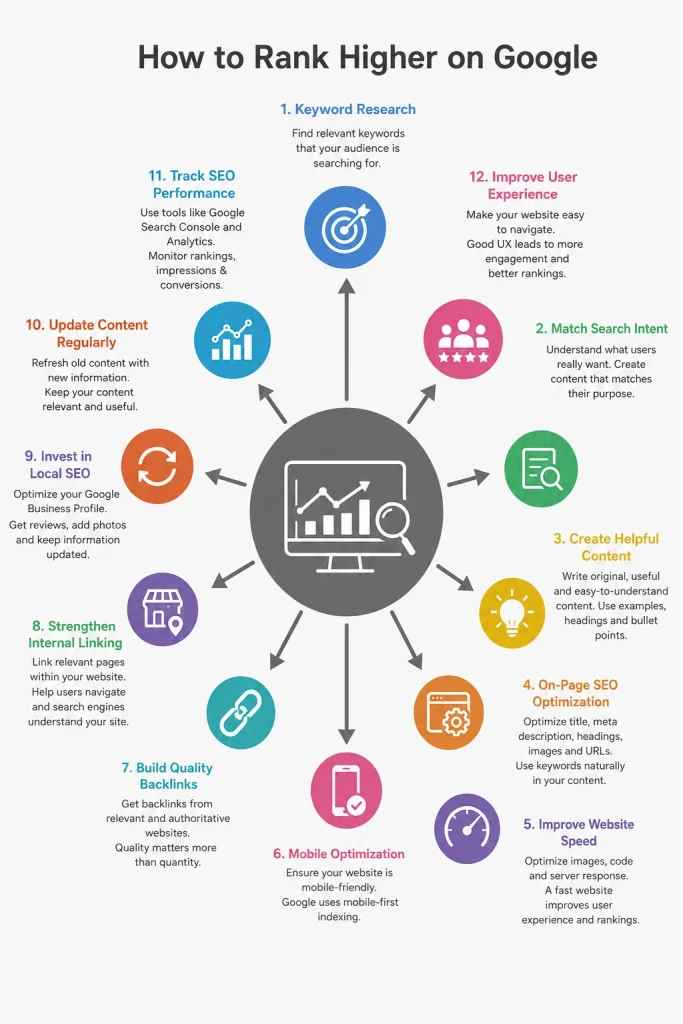
Start with proper keyword research, understand search intent, publish genuinely useful content, improve on-page and technical SEO, make your website fast and mobile-friendly, earn quality backlinks, strengthen local SEO, and track your results.
Most importantly, keep improving. Search visibility can change over time, so businesses that regularly review their websites and content are better positioned to maintain their rankings.
With a structured SEO strategy and consistent execution, your website can attract more relevant organic traffic, generate better leads, and build a stronger online presence. SIPL provides customized SEO and digital marketing services to help businesses work toward these goals through ethical, data-driven strategies.
FAQs
1. How can I rank higher on Google?
Start with keyword research, useful content, strong on-page SEO, technical optimization, quality backlinks, and regular performance tracking.
2. How long does it take to rank higher on Google?
SEO timelines vary. Competition, website authority, content quality, and technical factors can all affect how quickly rankings improve.
3. Do backlinks help improve Google rankings?
Yes. Relevant backlinks from trustworthy websites can strengthen your site’s authority and support better search visibility.
4. Is website speed important for SEO?
Yes. A fast website provides a better user experience and supports good page experience, which is important for modern SEO.
5. Does mobile-friendly design affect Google rankings?
A mobile-friendly website is essential because Google uses mobile-first indexing and many searches happen on mobile devices.
6. How often should I publish new content?
There is no fixed number of posts required. Focus on publishing useful, relevant content consistently rather than producing large amounts of low-quality content.
7. Should I use keywords in every paragraph?
No. Use keywords naturally where they make sense. Excessive keyword use can make content difficult to read and may lead to keyword stuffing.
8. Can local SEO help my business rank higher?
Yes. Local SEO can improve visibility for location-based searches and help nearby customers discover your business.
9. How do I know whether my SEO strategy is working?
Track organic traffic, impressions, clicks, keyword performance, conversions, indexed pages, and leads using tools such as Google Search Console and Google Analytics.
10. How can SIPL help improve my Google rankings?
SIPL offers SEO audits, technical SEO, on-page and off-page SEO, local SEO, keyword research, content marketing, website speed optimization, Google Business Profile optimization, and SEO performance tracking.